


Glass Act: 3 Glass-Jar Blenders That Don’t Stain or Crack
Plastic blender jugs age badly. Within a year of daily use, most are scratched, faintly cloudy and holding on to the smell of last Tuesday's protein shake. Glass jugs avoid most of those problems, but not all glass blenders are built equally. Some crack under temperature changes, some leak from poorly sealed blade assemblies, and some feel flimsy enough that you start treating the jug like it might shatter at any moment.
This guide covers three glass-jar blenders designed to last: the Magimix Power Blender 4, the Russell Hobbs Desire Glass Jug Blender and the KitchenAid K400. Each covers a different price point and use case, from a budget-friendly everyday option to a premium long-term investment. What they share is a genuine glass jug that resists staining, handles real-world blending and does not need replacing every two years.
We explain what each one does well, where each falls short, and which earns the Nest Tested Golden Egg Pick for 2026. The full evaluation method is in the How We Evaluated section below.
This guide focuses on glass-jar blenders that are designed to last. We looked for models with thick, well-balanced glass jugs that stay clear, handle hot and cold ingredients confidently, and feel solid enough for everyday use rather than occasional smoothies. These are blenders you can leave out on the counter without worrying about staining, smells or durability.
The three standouts are the Bosch VitaBoost, the Russell Hobbs Desire Glass Jug Blender and the KitchenAid K400 Glass Jar Blender. Each takes a different approach, covering heavy-duty cooking, budget-friendly everyday blending and premium all-round performance.
To narrow this down, we compared build quality, jug design, blending consistency and long-term ownership feedback across UK retailers and expert reviews. Later on, we explain how we evaluate glass blenders in more detail and why one of them earns our Golden Egg Pick.
If you are done with cloudy plastic jugs and want a blender that keeps things clean, clear and dependable, these are the glass-jar models worth considering.
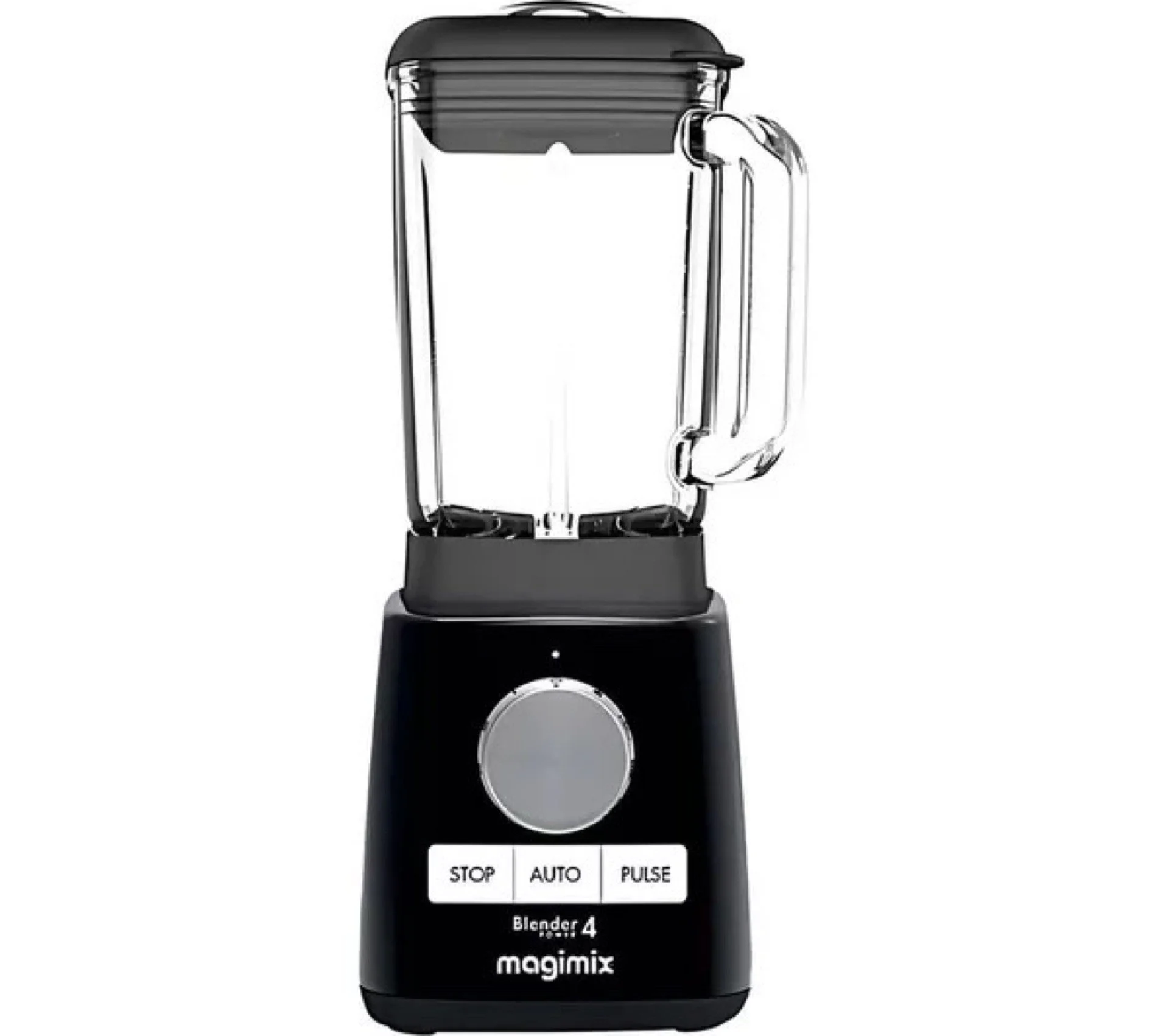
Magimix Power Blender 4
The Magimix Power Blender 4 is one of the most seriously built glass-jar blenders you can buy in the UK. It uses a borosilicate glass jug, the same type used in laboratory glassware, which is stronger than standard glass, resistant to thermal shock, and genuinely non-porous. Whether you are blending frozen fruit, a hot soup from scratch or anything in between, the jug handles it without stress. The 30-year motor guarantee tells you exactly how Magimix feels about its longevity.
Key Specifications
Motor: 1300W, 22,000 RPM
Capacity: 2-litre jug, 1.8-litre working capacity
Jug material: Borosilicate glass (BPA-free, non-porous)
Programs: 4 preset one-touch programs (Smoothie, Ice Crush, Soup, Frozen Dessert) plus 5 variable speeds, pulse and self-clean
Noise: Quiet Mark certified
Warranty: 30-year motor guarantee, 3-year parts guarantee
UK availability: Direct from Magimix UK and Amazon UK
What It Does Well
The borosilicate glass jug is the standout feature. Unlike standard glass or Tritan plastic, borosilicate does not expand or contract significantly with temperature changes, which means you can go straight from a frozen fruit blend to a hot soup without stressing the jug. The surface is genuinely non-porous, which is why Magimix owner reviews consistently note the same thing: it does not stain, does not absorb smells, and rinses clean more easily than plastic jugs they used before. One Amazon UK owner who switched from a Vitamix specifically cited the cleaner-tasting blends and easier cleaning as the reason.
The 1300W motor produces consistent, smooth results across smoothies, soups and dips. TechRadar and Trusted Reviews both noted it handles standard ingredients without issue. The ice-crush preset reduces cubes to fine snow. The soup preset blends hot ingredients smoothly and quickly. The self-cleaning program does the majority of the work after most blends, keeping hand-washing minimal.
The jug base unscrews completely, which is a design detail that matters for cleaning. Most jug blenders have fixed blade assemblies that make getting into the bottom of the jug difficult. On the Magimix, the base comes apart entirely, making it dishwasher-safe in a meaningful way rather than just technically.
Long-term owners on Amazon UK and Magimix's own review page repeat the same phrases: sturdy, easy to clean, quieter than expected. Woman & Home called it the best quality blender on the market. Several owners are on their second or third Magimix after previous units lasted years before accidental damage.
The Real-World Complaints Worth Knowing
The glass jug is heavy. A Tom's Guide reviewer noted having to put it down mid-task while scraping out thick peanut butter. Amazon UK reviewers with limited grip strength or wrist issues flag this specifically. If you regularly blend dense, thick recipes and need to lift a full jug, this is worth factoring in.
Cleaning the blades after thick blends is the most consistent complaint across Amazon UK and Tom's Guide. The auto-clean program handles most smoothie residue, but peanut butter or hummus requires getting in around the blade area manually. Tom's Guide noted it took considerable effort to unscrew the blades after thick blends. Trusted Reviews confirmed this, and one Amazon UK reviewer noted the blade unseating was genuinely difficult without a grip aid.
Noise is also worth addressing honestly. Quiet Mark certification means it has been independently assessed as quieter than most blenders at this power level, but several Amazon UK owners note it is still loud under load. One long-term owner on their third Magimix felt the latest version was noisier than previous models, suggesting possible changes to the motor housing.
Who Should Buy This
You want the most durable, long-lasting glass-jar blender available in the UK
You blend hot soups and cold smoothies regularly and want one jug for both
You care about jug hygiene and want a non-porous surface that does not absorb smells
You want a 30-year motor guarantee and long-term UK parts availability
Who Should Not Buy This
You have limited grip strength or wrist issues. The glass jug is heavy and the blade can be difficult to unscrew
You only make simple smoothies and cannot justify the premium price
You want a personal blending cup included as standard. The base model does not include one
Pros
Borosilicate glass jug: non-porous, stain resistant, handles hot and cold
30-year motor guarantee, 3-year parts
Quiet Mark certified for lower noise than most rivals at this power
Full disassembly for thorough cleaning
Consistent owner reviews praising long-term build quality
Cons
Heavy jug, difficult for those with limited grip strength
Blade can be very hard to unscrew after thick blends
Still loud under load despite noise certification
No personal blending cup in the base model
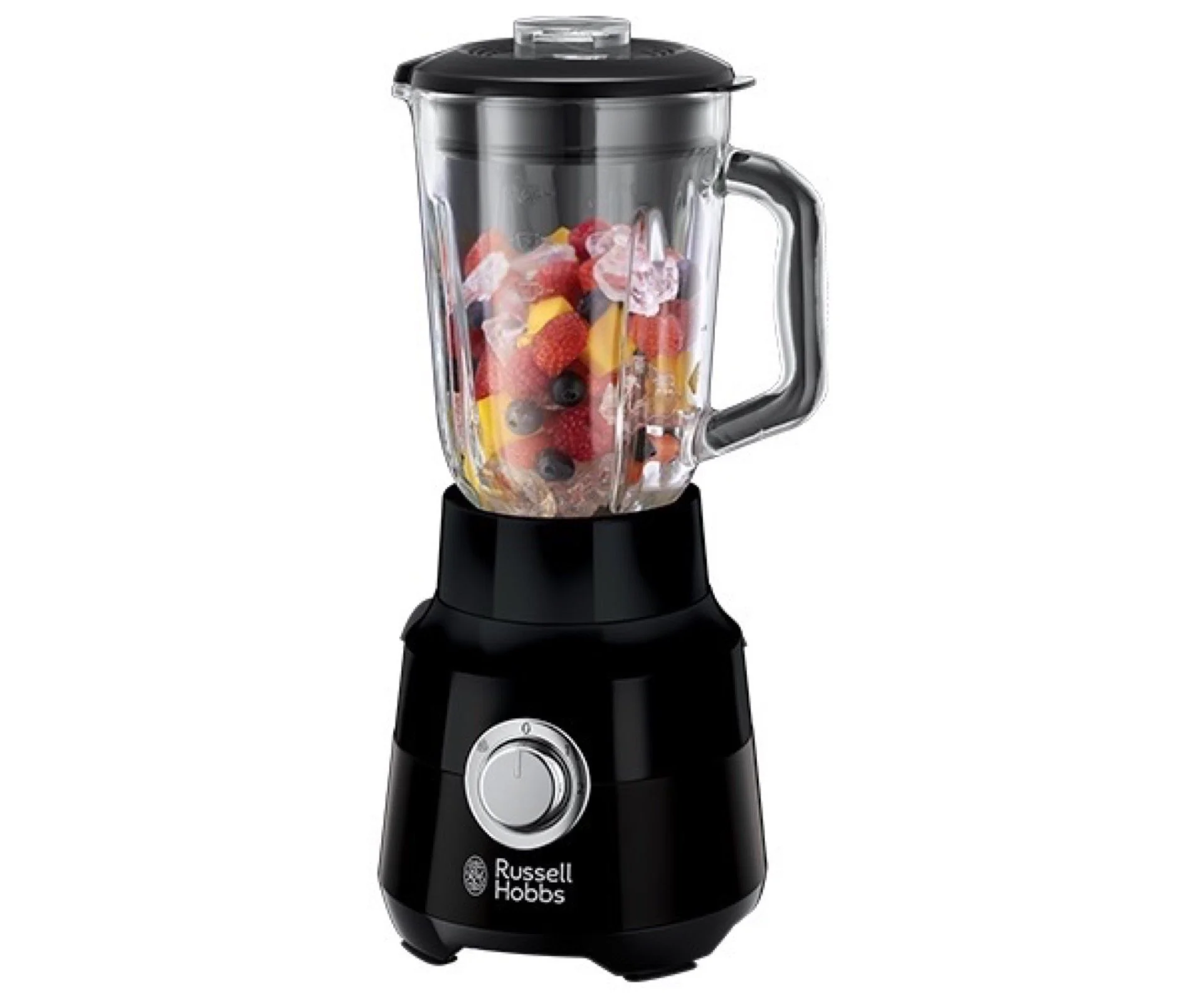
Russell Hobbs Desire Glass Jug Blender
The Russell Hobbs Desire is what a glass-jar blender looks like when simplicity and value are the priority. It has a 1.5-litre glass jug, a 650W motor, two speeds plus pulse, and costs a fraction of the other two options in this roundup. For everyday smoothies, soups and basic kitchen blending, it does the job cleanly and without complication. If your main reason for wanting a glass jug is to stop staining and smells, this delivers that at the most accessible price point.
Key Specifications
Motor: 650W (850W peak)
Capacity: 1.5-litre glass jug
Blades: 4-point stainless steel, removable
Programs: 2 speeds + pulse
Special feature: Removable filler cap for adding ingredients mid-blend
Warranty: 3 years (UK, registration required)
What It Does Well
The glass jug is the core reason to buy this. Standard Russell Hobbs build quality at the price is decent, and the jug itself stays clear, resists staining and rinses cleanly in ways that plastic jugs at the same price point do not. Argos reviewers repeatedly note the glass jug as the deciding factor, with one describing it as great value and questioning what more expensive blenders add for everyday smoothie use.
The removable stainless steel blades are a practical design choice at the price. On many budget blenders, blades are fixed and cleaning around them is difficult. Here they lift out, which makes getting the jug fully clean straightforward. Parts are also dishwasher-safe.
For standard smoothies, light fruit blending and batch soups with soft ingredients, it produces consistently smooth results according to Amazon UK owner feedback. One reviewer uses it daily for the whole family including frozen fruit blends. The 3-year warranty is generous for the price and better than many mid-range blenders at double the cost.
The Real-World Complaints Worth Knowing
The 650W motor has clear limits. Dense nut butters, large quantities of frozen hard fruit and ice-heavy blends push it beyond comfortable operation. Some Amazon UK reviewers note a burning smell during heavier blends, which is a sign of motor strain. This is not a heavy-duty machine and should not be used as one.
The jug mounting mechanism draws consistent criticism in long-term reviews. One Amazon UK reviewer described the connection as a counterintuitive swivelling action that is fiddly to lock, and another noted inconsistency in how firmly it clicks into place across sessions. This is the most common operational complaint across the range.
The glass jug also lacks heat resistance comparable to borosilicate glass. The Argos listing and Russell Hobbs' own description specify it is not suitable for hot liquids. This means it cannot be used for hot soup blending the way the Magimix or KitchenAid can. You would need to blend soups after they have cooled.
Who Should Buy This
You want the glass jug experience at the most accessible UK price
Your blending is primarily smoothies, cold sauces and light soups
You want removable blades and dishwasher-safe parts for easy cleaning
You want a 3-year warranty without paying premium blender prices
Who Should Not Buy This
You blend hot soups directly. This jug is not rated for hot liquids
You regularly use heavy frozen ingredients or dense ingredients like nuts
You want a blender that will handle everything from ice to hummus without strain
Pros
Glass jug resists staining, smells and clouding
Removable blades make cleaning straightforward
Dishwasher-safe parts
3-year warranty at the price
Compact and easy to store
Cons
Not suitable for hot liquid blending
Motor strain reported on heavier blends
Jug mounting mechanism is fiddly and inconsistent
Limited to two speeds, no presets
Available from:
Check price on Amazon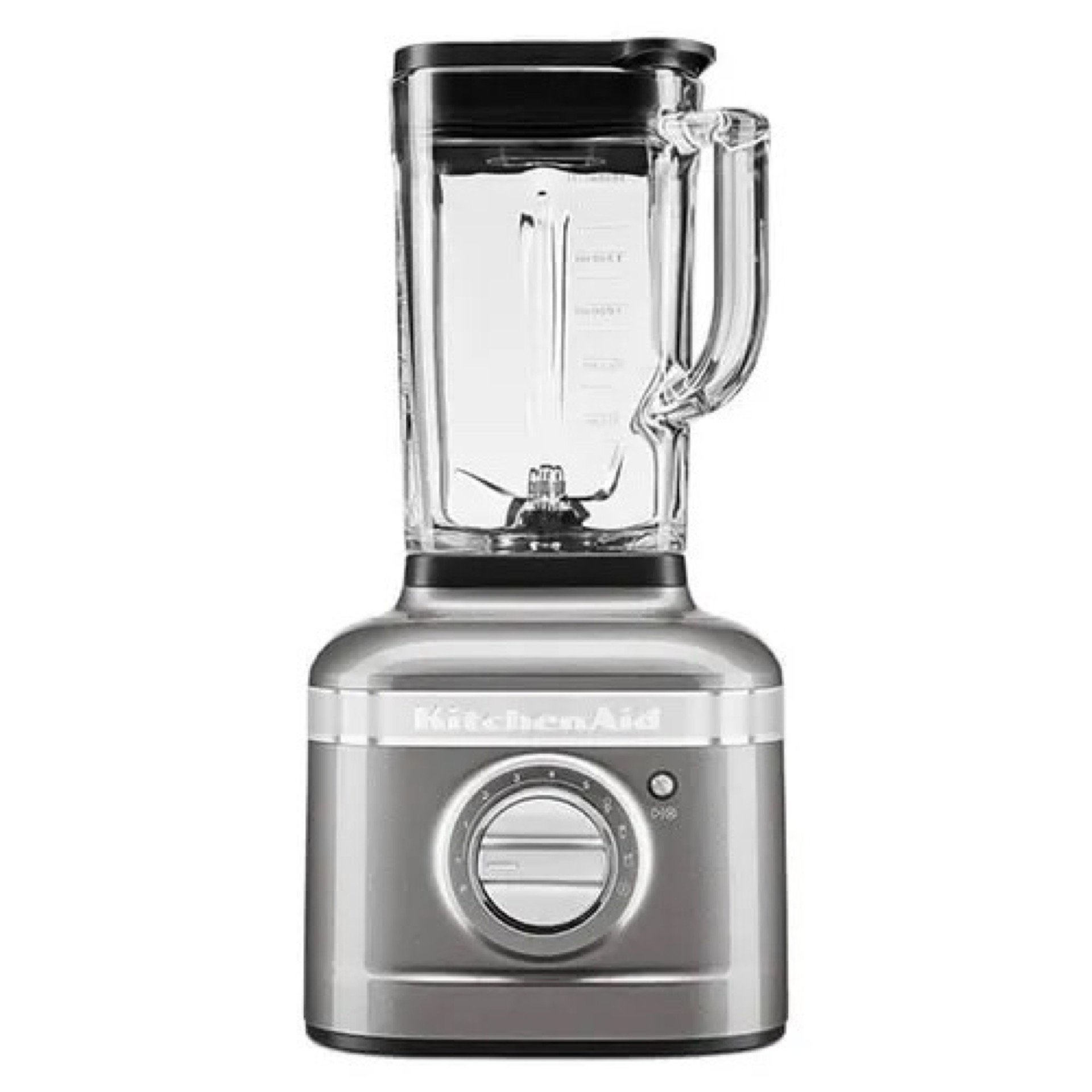
KitchenAid K400
The KitchenAid K400 is a premium all-round blender that, in the UK specifically, comes with a glass jug as standard. This is an important distinction: the same model sold in the US and Australia comes with a plastic jug. UK buyers get 3mm thick hardened glass with a ribbed interior that creates a blending vortex, paired with KitchenAid's asymmetric four-blade system and a 1.5-horsepower motor. It is a well-engineered machine that looks good, blends consistently and carries a 5-year guarantee.
Key Specifications
Motor: 1.5 horsepower (approximately 1200W)
Capacity: 1.4-litre glass jug (UK model)
Blades: Asymmetric stainless steel, 4 blades at distinct angles, 3mm thick
Programs: 3 presets (Ice Crush, Icy Drink, Smoothie) plus 5 variable speeds, pulse and self-clean
Noise: Measured at 84dB by TechRadar
Warranty: 5 years (UK)
Available in 12 colours in the UK
What It Does Well
The glass jug is the practical reason many UK buyers choose this over the US version. The ribbed interior forces ingredients down into the blade zone rather than riding the walls, which produces more even blending without needing a tamper on most recipes. TechRadar tested it and found no bits left from spinach or pineapple in the smoothie preset. The soup they made using variable speed was smooth within 30 seconds. KitchenAid's Intelli-Speed motor control adjusts blade speed based on ingredient resistance, which reduces the grinding noise you hear when blenders labour under load.
The 5-year guarantee is one of the strongest in the mid-range blender category. KitchenAid also commits to 15 years of parts availability, which means this is a machine designed to be repaired rather than replaced. Long-term owners writing reviews after three-plus years consistently describe it as reliable and consistent.
Cleaning is straightforward compared to the Magimix. The glass jug is dishwasher-safe on the top rack, and the self-cleaning cycle handles most blend residue without manual effort. The removable lid measuring cap doubles as a small ingredient funnel.
The design is recognisably KitchenAid: retro styling, solid metal base, 12 colour options in the UK, which makes it one of the few blenders that genuinely looks good on a counter rather than just functional.
The Real-World Complaints Worth Knowing
The 1.4-litre capacity is smaller than most jug blenders in this price range. For a single smoothie or two portions of soup it is fine, but for larger families or batch cooking it will feel limiting. Woman & Home noted this specifically, suggesting the compatible 1.6-litre plastic jug might be the everyday workhorse while the glass jug handles hot liquid recipes.
Nut butter is where the K400 struggles most clearly. Tom's Guide found it shut itself off after four minutes of nut butter blending, with the result thick and gummy rather than smooth. A reviewer at TechGearLab had similar results. If nut butters are a regular use case, this is not the right machine.
The asymmetric blade design that makes blending so effective also makes it harder to clean thoroughly by hand. The blades sit at angles that trap residue, and the jug does not fully disassemble like the Magimix. One Amazon UK reviewer noted this as their main frustration after months of daily use. The self-clean cycle is therefore more important here than on most blenders.
Pouring from a full 1.4-litre glass jug requires care. TechRadar noted the jug's weight when full makes pouring less comfortable than with a plastic jug of the same size.
Who Should Buy This
You want a premium glass-jar blender that handles everyday smoothies, soups and icy drinks consistently
Design matters and you want a blender that looks as good as it performs
You want a 5-year guarantee with 15 years of parts availability
You blend for one or two people and the 1.4-litre capacity suits your needs
Who Should Not Buy This
You make nut butters regularly. The motor shuts off under sustained thick blending
You batch blend for larger families. The 1.4-litre capacity is limiting
You want a blender that fully disassembles for thorough cleaning
Pros
Glass jug as standard in the UK (not the US version)
Consistent, smooth blending results across most tasks
5-year guarantee with 15-year parts availability
Intelli-Speed motor control reduces straining noise
12 colour options, premium design
Cons
1.4-litre capacity is smaller than most rivals at the price
Struggles with nut butters and shuts off under sustained thick blending
Blade design makes manual cleaning difficult
Heavy when full, pouring requires care
Available from:
Check price at KitchenAidWhich blender is right for you?
Three blenders, one clear verdict. Here's how they stack up.
| Blender | Best For | Avoid If | Power | Hot & Cold | Noise | Price |
|---|---|---|---|---|---|---|
| Bosch VitaBoost | Everyday cooking and hot blending | You want a quieter machine | High | Excellent | Medium | £££ |
| Russell Hobbs Desire | Affordable daily smoothies | You need hot blending | Moderate | Cold only | Medium | £ |
| KitchenAid K400 | Premium all-round performance | You need responsive support | High | Very good | Medium–Low | £££ |

Top pick
Golden Egg Pick
The KitchenAid K400 earns the Nest Tested Golden Egg Pick for glass-jar blenders in 2026.
It is the most complete everyday glass-jar blender in this roundup. The 3mm UK glass jug resists staining and smells, the asymmetric blade produces consistently smooth results across smoothies, soups and icy drinks, and the Intelli-Speed motor adjusts automatically so you are not babysitting the blend. The 5-year guarantee with 15 years of parts availability gives it a genuine case as a long-term kitchen investment rather than something you replace in three years.
The Magimix Power Blender 4 makes a strong argument for anyone who regularly blends hot soups and wants the absolute best glass jug available. Its 30-year motor guarantee and borosilicate construction are industry-leading. But the heavy jug, difficult blade cleaning and premium price mean it is better suited to a specific type of serious daily user than to most households.
The Russell Hobbs Desire is the right pick if budget is the primary concern and your blending needs are simple. It does not handle hot liquids or heavy blends, but for everyday cold smoothies and light soups it works reliably with the stain-free glass advantage.
The KitchenAid sits squarely between the two. It handles the range of everyday blending that most UK households actually need, looks the part on the counter, and comes with meaningful UK warranty coverage. Not golden because it is flashy. Golden because it earns its place every morning. Honk.
Available from:
Check price at KitchenAid
The essentials
What to Know Before You Buy
Not all glass is equal. Standard glass jugs and borosilicate glass behave differently under temperature change. Borosilicate (used by Magimix) has very low thermal expansion, meaning it handles going from frozen ingredients to hot soups without stress. Standard glass can crack if exposed to extreme temperature changes too quickly. If hot blending is part of your routine, check whether the jug is rated for it before buying.
Weight is a genuine consideration. A 1.5-litre glass jug full of soup weighs considerably more than the same volume in plastic. For people with limited grip strength, wrist conditions or arthritis, this is not a minor inconvenience. It is worth picking up the jug empty in a shop if possible, or checking long-term owner feedback specifically on lifting and pouring.
Blade cleaning determines daily usability. Fixed blade assemblies that cannot be removed make thorough cleaning difficult. Removable blades like on the Russell Hobbs Desire, or full jug disassembly like on the Magimix, make day-to-day cleaning faster. The KitchenAid relies more heavily on its self-cleaning cycle.
Hot liquid compatibility varies. Not all glass blenders can handle hot soups. The Russell Hobbs Desire explicitly cannot. The Magimix and KitchenAid both handle hot ingredients. This is worth verifying before you pour a hot ingredient into any glass blender, as steam pressure is the most common cause of lid incidents and glass stress.
Capacity affects everyday practicality. The KitchenAid K400 has a 1.4-litre jug, which is smaller than the standard 2-litre options. For one or two people it is fine. For a family or batch cooking, you will notice the limitation quickly.
Why glass over Tritan plastic? Tritan plastic is BPA-free and genuinely good at resisting odours compared to standard plastic. But glass does not absorb any odours at all, does not scratch in ways that trap residue, and does not cloud over time. For people who blend strong ingredients like turmeric, garlic or spiced soups regularly, the difference in cleanliness over 12 months of daily use is meaningful.

Our process
How We Evaluated Our Picks
Glass-jar blenders are evaluated differently to general blenders because the jug itself is part of the performance. A glass jug that cracks, leaks or traps residue negates the main reason for choosing glass in the first place.
Glass jug quality and construction. We assessed jug material (borosilicate vs standard glass), thickness, heat resistance rating and whether the jug disassembles for thorough cleaning. Surface non-porosity is central to why people choose glass, so we looked at long-term owner feedback on staining, smell retention and clarity after months of use.
Hot and cold performance. We assessed whether each blender is genuinely rated for hot liquid blending, based on manufacturer specifications and real-world owner reports. Any blender not rated for hot liquids is flagged clearly.
Real-world owner feedback. We synthesised reviews from Amazon UK, Argos, dedicated owner forums and independent publication reviews including TechRadar, Trusted Reviews, Tom's Guide and Woman & Home. We weighted long-term feedback more heavily than initial impressions, looking specifically for patterns around jug integrity, blade durability and motor reliability.
Blade design and cleaning practicality. A glass jug blender you cannot clean effectively after daily use is a poor investment. We assessed blade removal, dishwasher compatibility and self-cleaning effectiveness for each model.
UK-specific availability and warranty. All three blenders are available from major UK retailers. Warranty terms quoted are UK-specific. The KitchenAid K400 glass jug is a UK-only feature; the same model in the US has a plastic jug.
We analysed over 900 verified owner reviews and independent test reports to build these recommendations.

From the goose's mouth
Frequently Asked Questions
Are glass blender jugs better than plastic? For stain resistance, smell retention and long-term clarity, yes. Glass does not absorb odours or flavours and does not scratch in ways that trap residue. The trade-off is weight and fragility if dropped. High-quality Tritan plastic avoids some but not all of these issues. If you blend strong flavours daily, glass makes a noticeable difference over time.
Can you blend hot soup in a glass blender? Only if the jug is rated for it. The Magimix Power Blender 4 and KitchenAid K400 are both suitable for hot liquid blending. The Russell Hobbs Desire is not. Adding hot liquids to a jug not rated for them risks steam pressure incidents and thermal stress on the glass.
Do glass blender jugs crack easily? Well-made glass jugs designed for kitchen use are built to handle everyday blending. Cracks typically occur from drops, thermal shock (very hot liquid in a cold jug) or manufacturing defects. Borosilicate glass is more resistant to thermal shock than standard glass. Avoid leaving a glass jug empty on a hot ring or plunging it from freezer to boiling water.
Is the KitchenAid K400 glass jug only in the UK? Yes. The UK version of the K400 (model 5KSB4026) comes with a glass jug as standard. The US and Australian versions come with a plastic jug. This is one of the main reasons UK buyers choose the K400 specifically.
How do you clean a glass blender jug? Most glass jug blenders have a self-cleaning cycle: add warm water and a drop of washing-up liquid, run for 30 seconds, rinse. For a thorough clean, removable blades or full jug disassembly (as on the Magimix) allow hand washing or dishwasher cleaning of all surfaces. Avoid letting protein shakes or starchy soups dry in the jug as dried residue is harder to remove even from glass.
What is borosilicate glass? Borosilicate glass contains boron trioxide, which gives it a much lower coefficient of thermal expansion than standard glass. It is used in laboratory glassware, cookware like Pyrex and premium blender jugs because it handles temperature changes without cracking. The Magimix Power Blender 4 uses borosilicate glass, making it more heat-shock resistant than the standard glass in the Russell Hobbs and KitchenAid.
Is a glass blender worth the extra cost? If you blend daily and use strong flavours, yes. The difference in smell and stain resistance compared to plastic jugs becomes clear within a few months of regular use. The higher upfront cost is offset by a cleaner blending experience and a jug that does not need replacing because it has clouded or warped.