


Looks That Kill (Smoothies) – The Best Design-Led Blenders of 2026
Not all blenders deserve a permanent place on your kitchen counter. Some look great but struggle the moment frozen fruit appears. Others blend brilliantly but dominate the space like a small appliance crime scene. If you care about how your kitchen looks as much as how your smoothies turn out, that is a frustrating compromise to make. No need to flap around the whole article like a lost goose.
Three types of buyer tend to search for a design-led blender. The first wants a statement piece for a curated kitchen, ideally something that coordinates with other appliances, where looks genuinely come first and the blending just needs to be solid. The second wants a premium blender where engineering and aesthetics are treated equally, a machine that looks considered and performs to match. The third wants something that blends the full range well, looks the part, and lasts for years, without being the most expensive option in the category.
The Smeg BLF03 Retro Blender is for the first group. The Zwilling Enfinigy Power Blender is for the second. The KitchenAid K400 is for the third.
If design is your primary filter and you already have Smeg appliances in the kitchen, go straight to the Smeg. If you want the best blending performance alongside the aesthetics and budget is not your main concern, the Zwilling is the stronger machine. If you want reliable everyday performance, a wide colour range and a glass jug that lasts, the KitchenAid earns its counter space.
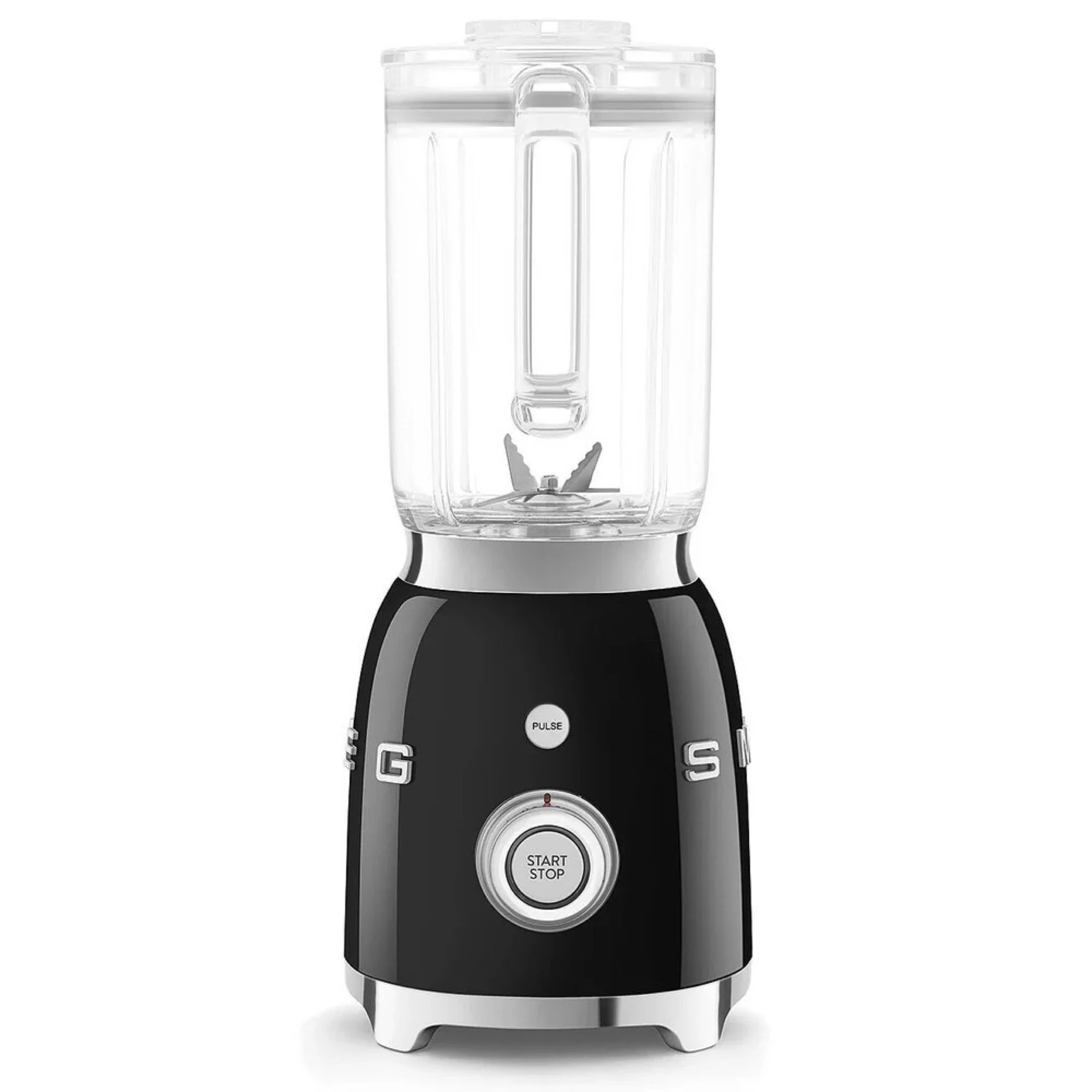
Smeg BLF03 Retro Blender
The Smeg BLF03 is one of the most recognisable blenders in any UK kitchen shop or design magazine. Its 1950s-inspired die-cast aluminium body, signature high-gloss finish and wide colour range, including pastel blue, pastel green, cream, red, pink and black, have made it a favourite for households where the look of the kitchen matters as much as what comes out of it. People put this blender on social media. They leave it on the counter because it earns the visual real estate. The question is whether the blending keeps up.
For everyday smoothies, it does. This is a blender built for regular fruit blends, protein shakes, soft frozen fruit and light sauces. It is not trying to be a workhorse. It is trying to be the best-looking blender that also does a good job.
Key Specifications
Motor: 800W
Capacity: 1.5L Tritan BPA-free jug
Blade: Stainless steel, fixed
Controls: Dial with 4 speeds, Smoothie, Green Smoothie, Ice Crush and Pulse presets
Build: Die-cast aluminium body, anti-slip feet, cord storage in base
Warranty: 2 years
What It Does Well
For fruit smoothies, protein shakes and blended soups made from cooled ingredients, the BLF03 produces clean, consistent results. Woman and Home tested it on bananas, spinach, frozen pineapple, kiwi, ice, avocado, oats and almond milk and described the result as flawless for a full smoothie blend. The preset modes, particularly Smoothie and Ice Crush, remove the guesswork for buyers who want to press and walk away.
The build quality is genuine. The die-cast aluminium base does not rattle or walk on the counter during use. TechRadar describes it as reassuringly sturdy, and the anti-slip feet keep it planted. The cord slots neatly into the base, which matters when the whole point is a tidy countertop. The colour range is unmatched in this category: no other blender here offers eight colour options that tie directly into a full small appliance ecosystem including matching kettles, toasters and coffee machines.
Real-World Complaints Worth Knowing
The 800W motor is mid-range for the price. TechRadar's review of the BLF01 (same generation) found the four-speed dial has a limited range from 1 to 4, which is narrower than competitors offering 10-step control. For thick blends that need progressive speed management, this matters. Woman and Home noted the BLF03 struggled with lower-liquid content blends such as acai bowls and ice cones where the motor cannot generate enough pull without sufficient liquid.
The jug cannot be used for hot ingredients. Homes and Gardens flagged this as a meaningful limitation: if you want to blend a roasted vegetable soup, you need to wait for ingredients to cool first. For a blender at this price point competing against machines that handle hot liquids directly, that is worth knowing before buying.
Amazon UK reviewers note that the control dial markings are positioned on the top of the unit rather than the front, which makes settings less visible when the blender is at counter height. Several buyers mention this as a minor but persistent annoyance.
Who Should Buy This
You already have Smeg appliances and want a matching blender for a coordinated kitchen
Your primary use is daily fruit smoothies, shakes and light blending tasks
Design is genuinely a top-three buying criterion, not just a nice-to-have
You want something that looks good enough to leave on the counter permanently
Who Should Not Buy This
You want to blend hot soups directly in the jug. The Tritan jug is not designed for hot ingredients
You make dense blends with nut butters, thick frozen mixes or low-liquid recipes regularly. The 800W motor will struggle
You want variable speed control with more than four positions. The dial is limited
Budget is tight. You are paying a significant premium for the design and brand
Pros
Instantly recognisable design with the widest colour range of the three machines here
Solid die-cast aluminium build with minimal vibration
Preset modes produce reliable results for everyday smoothies
Coordinates with a full Smeg appliance ecosystem
Cord storage keeps the counter clean
Dishwasher-safe jug
Cons
800W motor is mid-range for the price; cannot handle hot liquids or very thick dry blends
Only four speed settings, narrower than competitors
Jug limited to cold and room-temperature ingredients only
Control markings are on top of the unit, less visible at counter height
Available from
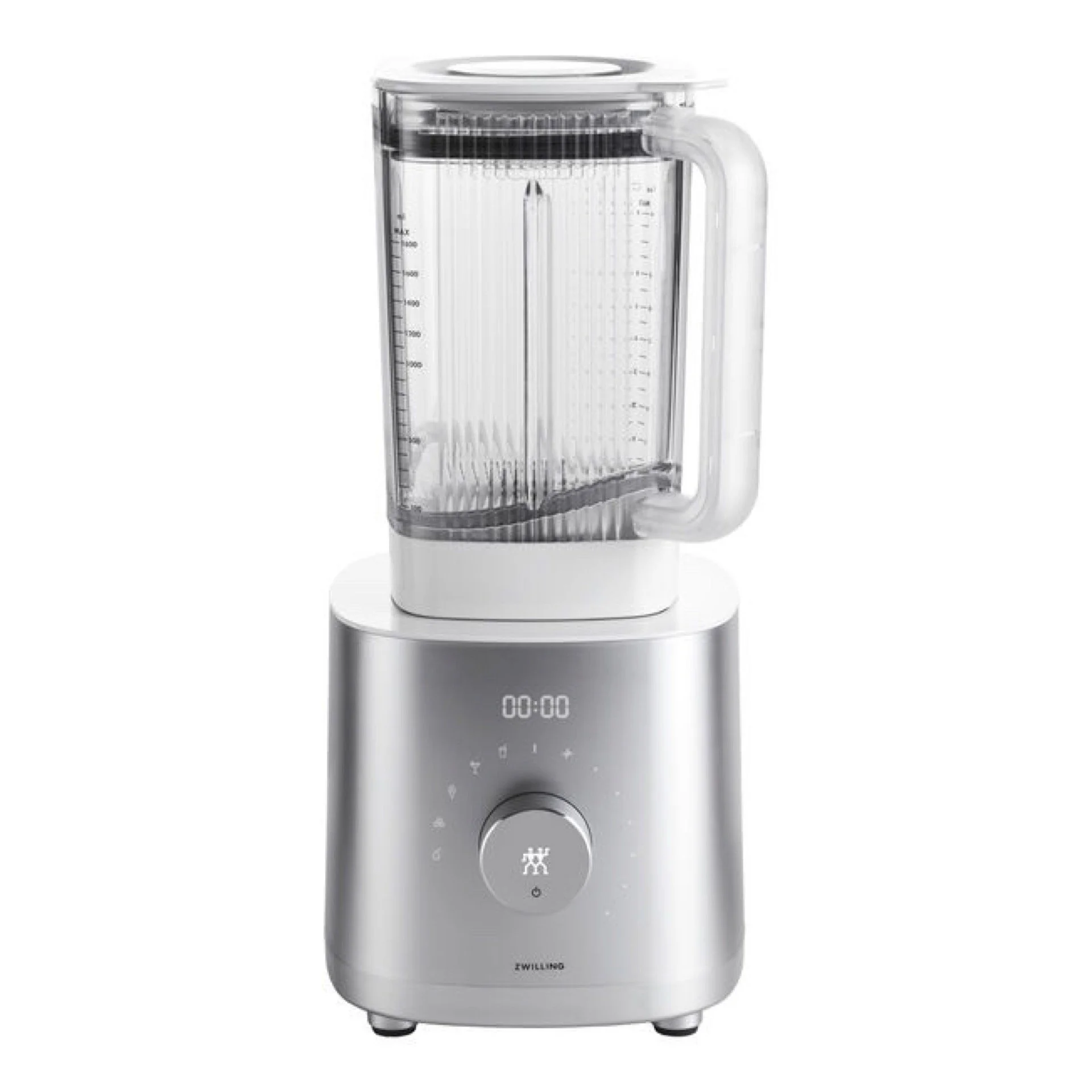
Zwilling Enfinigy Power Blender
The Zwilling Enfinigy Power Blender is for buyers who want performance and design to be treated with equal seriousness. Zwilling is best known for its German kitchen knives, and it brings the same engineering precision to this blender: the blade is German-made with a winglet design, the motor is 1,600W, and the jug holds 1.8 litres. The design is deliberately understated, a frost silver and matte finish that fits modern kitchens without demanding attention. It is a machine that looks like it belongs in a serious kitchen rather than a lifestyle shoot.
Tech Advisor described it as conjuring an image of a well-equipped bar top; Homes and Gardens praised the sheer blending power. This is not a decorative purchase. It is a performance blender that happens to look excellent.
Key Specifications
Motor: 1,600W
Capacity: 1.8L Tritan jug
Blade: German-made winglet stainless steel, fixed
Controls: Central dial, 12 manual speeds, 5 presets (Smoothie, Cocktail, Iced Desserts, Ice, Self-Clean), plus Pulse
Build: Stainless-painted plastic housing, automatic pitcher detection, lid safety lock
Warranty: 5 years (upon registration)
What It Does Well
The 1,600W motor and German winglet blade produce genuinely impressive results on everything from frozen fruit smoothies to blended soups and nut butters. Homes and Gardens tested it on frozen banana, blueberries and raspberries and noted the blender handled them with ease where many machines struggle with smaller frozen quantities. The blade geometry creates a strong vortex that pulls ingredients down rather than just spinning them sideways, which produces a more even result on thicker blends.
The 12-speed dial gives fine manual control that neither the Smeg nor the KitchenAid can match. TechRadar praised the clean aesthetic: controls are invisible when the machine is off, then illuminate when the jug is placed on the base. The lid lock is a strong safety feature: the blender will not start unless the lid is correctly in place, and shuts off automatically if the lid is accidentally removed mid-blend. The 5-year warranty is the strongest of the three machines here.
The vacuum-seal insert in the lid is a useful addition for batch cooking: you can attach a Zwilling Fresh and Save pump to seal leftover soup or smoothie in the jug itself, slowing oxidation. This is not a feature most buyers will use daily, but it is the kind of considered detail that reflects how the machine is designed.
Real-World Complaints Worth Knowing
TechRadar found the ice crush programme produced chunkier results than expected, with less consistent ice texture than the smoothie and blending programmes. Home Depot reviewers echo this: some report needing to run cycles twice when working with dates or small dense ingredients that do not always catch in the blade on the first pass.
The jug is not dishwasher safe, confirmed by TechRadar. For a machine at this price, that is a genuine inconvenience. The self-clean programme handles most residue effectively, but buyers who prefer dishwasher loading should factor this in.
Home Depot buyer reviews flag a fragility issue with the lid tab: the plastic opening mechanism can crack under pressure if pulled or pushed too forcefully. Zwilling's customer service replaced it in the reported case, but it is a design weakness on an otherwise robust machine.
Who Should Buy This
You want the best blending performance of the three machines here and design restraint to match
You blend daily and want a machine that handles everything from smoothies to soups to nut butters
The 5-year warranty is important to you as a long-term purchase
Your kitchen is modern or minimalist and you want an appliance that fits without dominating
Who Should Not Buy This
You want dishwasher-safe jug cleaning. The Enfinigy pitcher is hand-wash only
You want a machine that coordinates with a full colour-matched appliance ecosystem. The Zwilling range is limited to silver and black
Budget is the primary concern. This is the most expensive machine here
You mainly crush ice. TechRadar found ice-crush performance to be the weakest programme
Pros
1,600W motor delivers the strongest blending performance in this comparison
German winglet blade produces excellent results on frozen fruit, greens and dense ingredients
12-speed manual control gives precision that the other two machines lack
Lid safety lock prevents accidental starts
5-year warranty upon registration, the best here
Sleek, modern design that works in contemporary kitchens without dominating
Cons
Jug is not dishwasher safe
Ice crush programme produces inconsistent results compared to other presets
Lid tab plastic can crack under heavy-handed use
Limited colour options compared to Smeg and KitchenAid
The most expensive option here
Available from
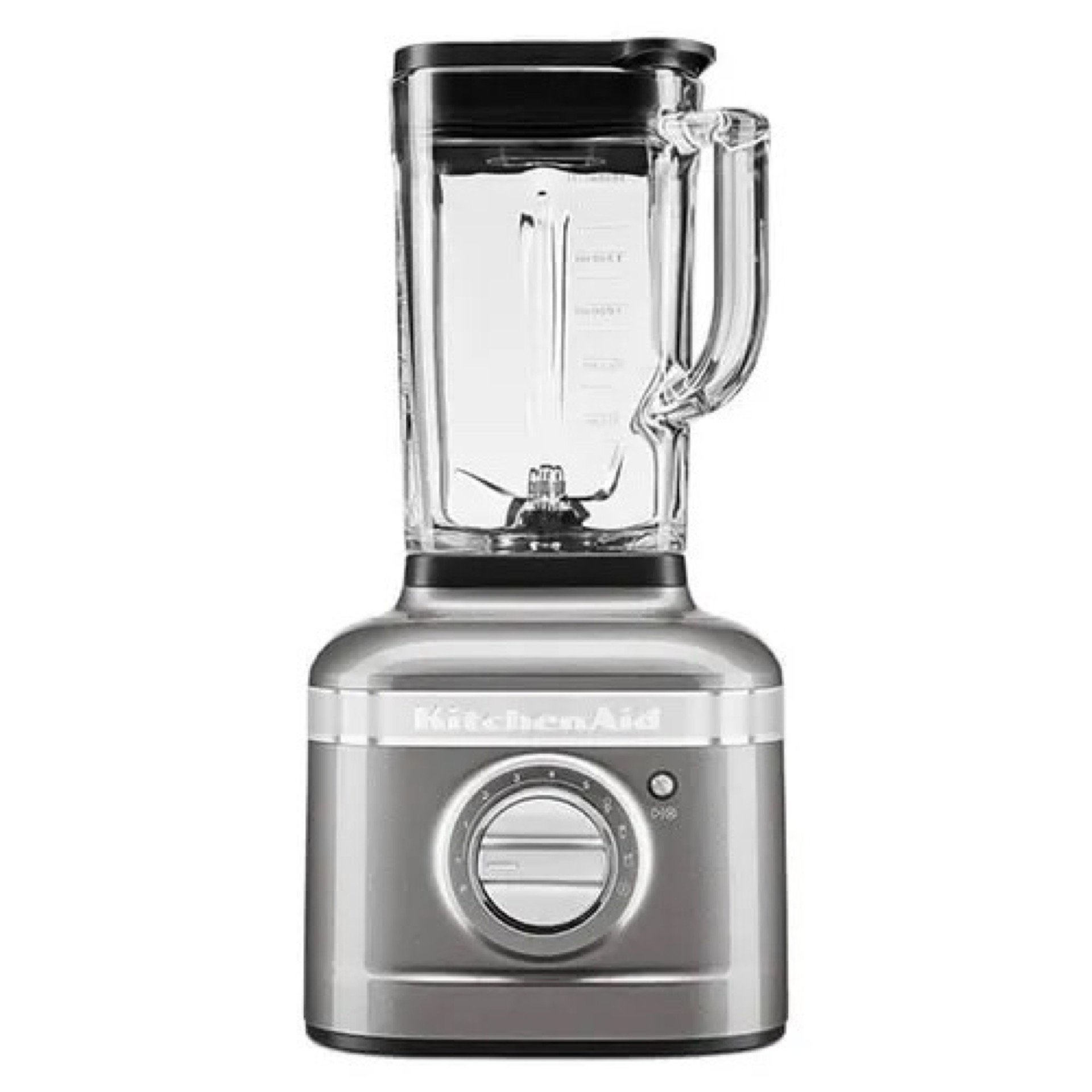
KitchenAid K400 Blender
The KitchenAid K400 sits at the practical centre of this category. It is design-led without being purely about aesthetics. The die-cast metal base, retro-influenced styling and wide colour range, 12 options in the UK, make it easy to integrate into most kitchens, especially those that already have KitchenAid appliances. Unlike the Smeg, the UK version comes with a glass jug rather than plastic, which adds heft but improves long-term stain and odour resistance. Unlike the Zwilling, it is priced more accessibly and has a stronger track record of UK retail availability.
The K400's design principle is coherence. It does not try to be the most powerful blender or the most striking. It tries to be the blender that looks right, blends reliably and lasts for years without demanding constant attention.
Key Specifications
Motor: 1.5 horsepower (approximately 1,100W continuous)
Capacity: 1.4L glass jug (UK version)
Blade: Asymmetric stainless steel, fixed, four-point design
Controls: Single dial with 5 speeds, Pulse, Smoothie, Ice Crush, Icy Drinks and Self-Clean presets
Build: Die-cast metal base, ribbed jug design for vortex circulation, Intelli-Speed motor control
Warranty: 5 years (UK)
What It Does Well
The glass jug is the K400's most practical advantage in a design-led context. Cooking with Elo's three-year owner review specifically highlights that the glass version sold in the UK and Europe shows no staining, greasy residue or odour after years of daily use, including blending turmeric. The ribbed jug interior and asymmetric blade work together to create a circulation vortex that pulls ingredients back into the blades, which reduces the need to stop and scrape during thicker blends.
TechGearLab testing found the K400 produced a velvety smooth smoothie and a near-perfect milkshake. TechRadar's test found the ice crush programme tackled ice cubes at 84dB with evenly crushed results. Intelli-Speed motor control adjusts blade speed based on ingredient resistance, which means the blending adapts to what is in the jug rather than running at a fixed speed regardless of load.
The colour ecosystem is a genuine differentiator. KitchenAid offers 12 colour options in the UK, from classic Empire Red and Onyx Black to Pistachio, Beetroot, Lemon and Honey Orange. Buyers who already own KitchenAid stand mixers, toasters or kettles can match precisely.
Real-World Complaints Worth Knowing
Tom's Guide found the control dial feels wobbly and moves without resistance or clicks, making it easy to overshoot the intended setting. Homes and Gardens echoed this: twisting too far past maximum speed accidentally engages a preset mode and shuts the blender off, which requires restarting. It is a minor but repeatable frustration during daily use.
The UK Trustpilot reviews for KitchenAid as a brand are poor, with multiple buyers reporting difficulty reaching customer service and slow warranty resolution. One Trustpilot reviewer describes spending months trying to resolve a blender issue with no response to emails. This is a brand-level complaint rather than a product-level one, but it is relevant for buyers who weigh after-sales support when spending this amount.
Top Ten Reviews noted that food can lodge below the fixed blade area and is difficult to remove, requiring a spoon or brush to dislodge. This is more relevant for thick blends like hummus than for smoothies, but worth knowing for daily heavy use.
Who Should Buy This
You want a design-led blender with a glass jug for long-term stain and odour resistance
You already own KitchenAid appliances and want a colour-matched blender
You blend daily and want reliable performance across smoothies, soups and light sauces
You want a 5-year warranty at a more accessible price than the Zwilling
Who Should Not Buy This
You struggle to lift heavy appliances. The glass jug and metal base make the K400 one of the heaviest machines here
You need responsive customer service. KitchenAid's UK after-sales reputation is a documented concern on Trustpilot
You want more than four blending presets or more than five manual speeds
You blend very small quantities. The 1.4L jug does not perform as well with minimal liquid at the bottom
Pros
Glass jug (UK version) resists staining, odour and long-term discolouration
Intelli-Speed motor adjusts to ingredient resistance for more consistent results
Wide colour range, 12 UK options, including a match for every existing KitchenAid appliance
Ribbed jug and asymmetric blade create strong vortex circulation
5-year UK warranty
Self-clean programme included
Cons
Control dial is wobbly with no click feedback; easy to overshoot settings
Heavy due to glass jug and metal base
Food can lodge under the fixed blade on thicker blends
KitchenAid UK customer service has documented complaints on Trustpilot
1.4L jug is smaller than the Zwilling and more limited for batch blending
Available from
Which design-led blender is right for you?
Three blenders worth looking at, one clear verdict. Here's how they stack up.
| Blender | Best For | Avoid If | Power | Capacity | Warranty | Price |
|---|---|---|---|---|---|---|
| Smeg BLF03 | Coordinated Smeg kitchens | You need hot blending | 800W | 1.5L Tritan | 2 years | £££ |
| Zwilling Enfinigy Power | Performance and design both | You want dishwasher cleaning | 1,600W | 1.8L Tritan | 5 years | ££££ |
| KitchenAid K400 | Daily use, glass jug, colours | You need responsive support | 1.5HP (~1,100W) | 1.4L glass (UK) | 5 years | £££ |

Top pick
Golden Egg Pick
The KitchenAid K400 earns the Nest Tested Golden Egg Pick.
The Smeg BLF03 is the most visually distinctive machine here and earns its counter space in the right kitchen. But 800W is not enough for anything beyond straightforward smoothies and fruit blends, the jug cannot handle hot ingredients, and the four-speed dial is limiting for buyers who blend a range of recipes. You are paying substantially for the design, and for the right buyer that is a legitimate trade. For most buyers, it is not enough blender for the money.
The Zwilling Enfinigy Power Blender is the strongest performer of the three. The 1,600W motor, German winglet blade and 12-speed control are genuinely impressive, and TechRadar and Homes and Gardens both praised the blending quality. But the jug is not dishwasher safe, the ice-crush programme underperforms relative to what the price suggests, and the lid tab has a documented fragility issue. At the top end of this price bracket, those limitations matter.
The KitchenAid K400 holds the middle ground for good reason. The glass jug, unique to the UK version, is a meaningful long-term advantage: no staining, no odour retention, no plastic clouding after years of turmeric and berry blends. The Intelli-Speed motor adapts to ingredient load rather than running at fixed speed. The 12 UK colour options cover every kitchen aesthetic from classic red to Beetroot to Pistachio. The 5-year UK warranty matches the Zwilling. And the price is more accessible than the Enfinigy without the performance compromises of the Smeg.
The wobbly dial and KitchenAid's customer service reputation are real concerns. But as a machine that blends well, looks excellent and lasts, the K400 delivers the most complete package for the widest range of buyers in this category.
Available from

The essentials
What to Know Before You Buy
Design in this category is a legitimate purchase criterion, not a vanity. Blenders that live on the counter permanently are visible every day. A blender that makes you wince every time you look at it is a poor buy regardless of its blending performance. The relevant questions are: does the design fit your kitchen without dominating it, does the finish hold up over time, and does the appliance coordinate with what is already on the counter? All three machines here clear that bar in different ways.
Motor power matters more in this category than it is usually acknowledged. The gap between 800W and 1,600W is real for anything beyond soft fruit smoothies. If you regularly blend frozen ingredients, leafy greens, oats or nut butters, a stronger motor produces a smoother result without multiple cycles. The Smeg's 800W is fine for its target use case. It is not fine if you are trying to replace a higher-powered blender with it.
Jug material affects long-term satisfaction more than short-term performance. Plastic Tritan jugs are lighter, less fragile and good for daily use, but over months of blending turmeric, beetroot or protein powders, they can absorb colour and odour in ways that glass does not. The KitchenAid K400 UK version ships with a glass jug, which is a meaningful advantage for buyers who blend daily and want the machine to look and smell clean two years from now.
Colour matching is more of a genuine consideration than it sounds. KitchenAid and Smeg both sell full small appliance ranges in coordinating finishes. If you already own a KitchenAid stand mixer or a Smeg kettle, buying the corresponding blender in the matching colour produces a kitchen aesthetic that feels intentional rather than assembled from mismatched purchases. The Zwilling does not offer this: it comes in silver and black only.
Customer service matters for premium appliances. A blender at this price is an investment. If something goes wrong in year two, the ease of making a warranty claim is a practical concern. Zwilling and KitchenAid both offer 5-year warranties on these machines, but KitchenAid's UK customer service has documented complaints on Trustpilot, with multiple buyers reporting slow or no response to warranty claims. Smeg's warranty support is less widely reported but the 2-year term is shorter than the other two. Research the after-sales experience before committing.
Presets are only useful if they match how you actually blend. All three machines include smoothie and ice crush programmes. The Zwilling adds cocktail, iced desserts and a vacuum-seal function. The KitchenAid adds icy drinks. The Smeg adds a green smoothie preset specifically designed for leafy green blends. Whether these presets reflect your actual use matters more than the total number of modes. One good preset you use daily is more valuable than six you never touch.

Our process
How We Evaluated Our Picks
We assessed these three blenders against a set of criteria specific to design-led buyers, where aesthetics and performance are both genuine purchase drivers rather than one being secondary to the other.
Our starting point was blending performance for everyday use cases. We drew on testing from TechRadar, Homes and Gardens, Tom's Guide, Woman and Home and TechGearLab, looking specifically at smoothie consistency, frozen fruit performance, noise levels and how each machine handles thicker blends over time. Short-term test results were cross-referenced against longer-term owner feedback from Amazon UK and Trustpilot to identify recurring issues that do not appear in initial reviews.
Design assessment went beyond aesthetics. We considered proportions, material quality, finish durability, control layout and how each machine fits into a real UK kitchen rather than a studio setting. The ability to coordinate with existing appliances was treated as a legitimate feature, not a gimmick, because for buyers in this category it directly influences whether the blender stays on the counter or ends up in a cupboard.
Factual accuracy was checked against product listings and expert reviews, and discrepancies in the original article were corrected before writing. Notably, the KitchenAid K400 sold in the UK ships with a glass jug, not a plastic one as sometimes listed, and the Zwilling Enfinigy Power Blender runs a 1,600W motor, not 1,200W.
Long-term reliability data came from Trustpilot reviews of brand customer service, iFixit community threads, Amazon UK verified buyer feedback and owner reports on Reddit and home appliance forums. Products with consistent patterns of early failure or poor warranty resolution were assessed critically rather than dismissed outright, since the after-sales experience is part of the total cost of ownership for an appliance at this price.

From the goose's mouth
Frequently Asked Questions
Which design-led blender is best for smoothies in the UK? The KitchenAid K400 offers the most complete balance of smoothie performance, design flexibility and long-term durability. The Zwilling Enfinigy Power Blender produces smoother results at higher power, but costs significantly more and has a less versatile jug design.
Is the Smeg BLF03 actually a good blender or just pretty? It is a genuinely capable blender for everyday fruit smoothies and protein shakes. Woman and Home tested it on a complex smoothie blend with frozen fruit, oats and greens and found it performed well. The limitations are the 800W motor for thick blends and the inability to blend hot liquids. For its target use case, it does the job.
Does the KitchenAid K400 come with a glass or plastic jug in the UK? The UK version comes with a glass jug. The US version has a plastic jug. This is confirmed by multiple UK reviews including Homes and Gardens and Cooking with Elo, and is a meaningful distinction because glass resists staining and odour better over time.
Why is the Zwilling Enfinigy Power Blender more expensive than the others? The 1,600W motor, German-made winglet blade, 12-speed manual control, 5-year warranty and vacuum-seal lid feature justify the premium for serious daily blenders. You are paying for performance headroom and engineering quality rather than just aesthetics.
Is the Zwilling Enfinigy Power Blender dishwasher safe? No. TechRadar confirmed the jug is not dishwasher safe. The self-clean programme handles most residue effectively, but manual cleaning is required.
Do all three blenders handle hot soups? No. The Smeg BLF03 jug is not designed for hot ingredients at all. The KitchenAid K400 glass jug can handle hot ingredients, though you should start on low speed and remove the lid centre piece to vent steam. The Zwilling can process hot ingredients and also generate heat through sustained high-speed blending.
Which blender has the best colour options in the UK? KitchenAid offers 12 colour options for the K400 in the UK, which is the widest range. Smeg offers eight colours across cream, pastel blue, pastel green, pink, red, black, white and grey. Zwilling is available in silver and black only.
Are design-led blenders worth the premium over a standard blender? If the blender will live permanently on your counter, the answer is yes for most buyers. The daily visual impact of an appliance you see every morning is a real factor. The machines here also perform well rather than just looking good, so the premium covers both design and capability.