

Small But Savage: 3 Mini Blenders That Punch Above Their Weight (2026)
Mini blenders have a reputation problem. They look neat, promise convenience, then struggle the moment frozen fruit or a scoop of protein powder goes in. If you have ever owned one that wheezed its way through a banana, you will understand the frustration.
This guide focuses on the small blenders that break that pattern. We looked specifically at compact models that can handle real smoothie ingredients without taking up valuable counter space or feeling disposable after a few months. These are blenders designed for small kitchens, flats, desks and gym bags, not just for show.
The three standouts are the Ninja Blast Cordless Portable Blender, the NutriBullet Pro 900 and the Beast Blender. Each takes a slightly different approach to size, power and portability, which is why they earn their place here rather than being lumped together as “mini” by default.
To make this shortlist, we compared blending performance, everyday usability, noise levels and long-term ownership feedback across leading UK retailers and expert reviews. We also looked at how well these blenders cope with thicker smoothies and frozen ingredients, because that is where most compact models come unstuck and end up flying the nest.
Later on, we explain exactly how we evaluate products like these and why one of them earns our Golden Egg Pick. For now, think of this as a reality check for small blenders that claim to be mighty, and a guide to the few that actually are.
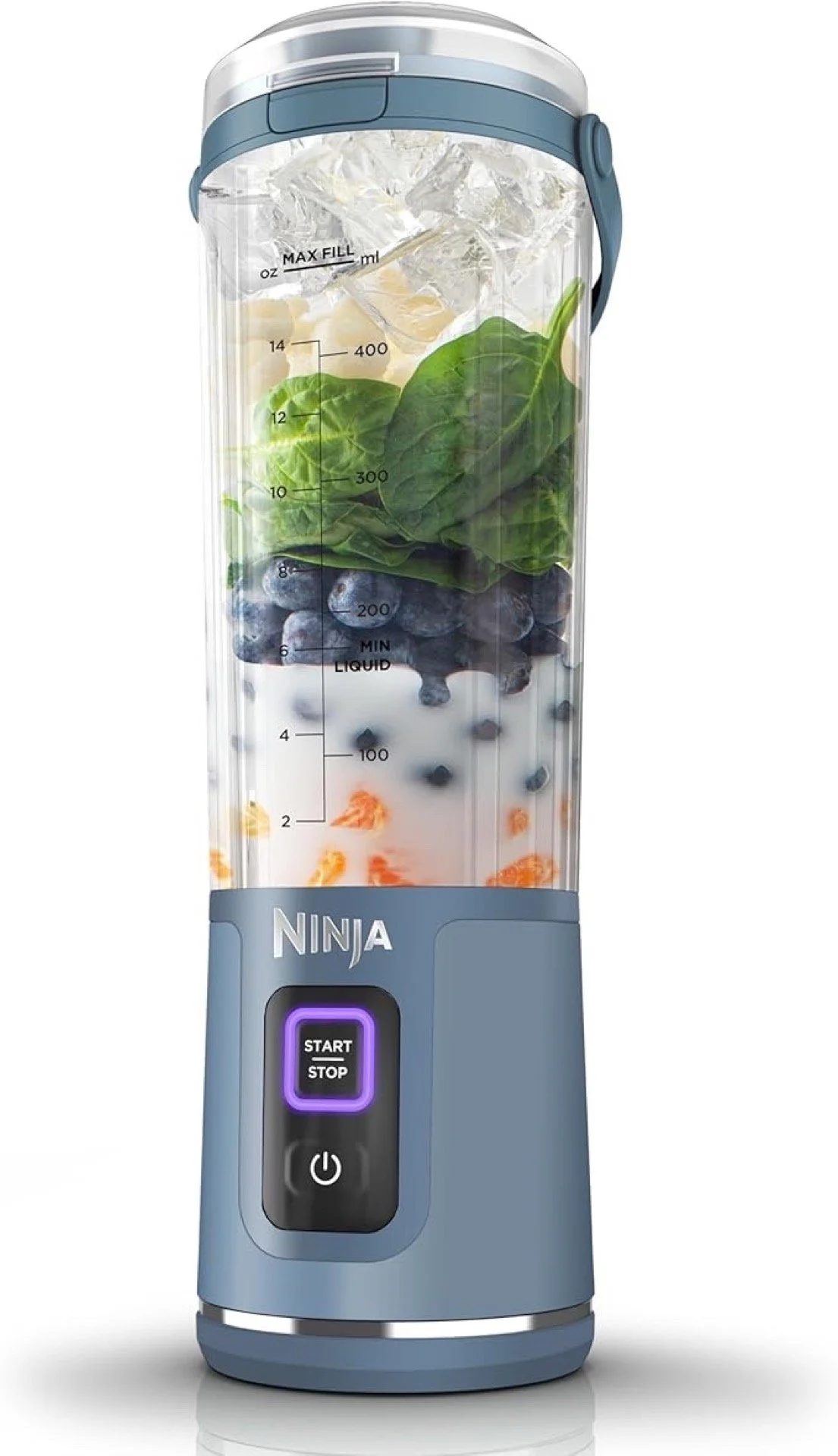
Ninja Blast Cordless Portable Blender
The Ninja Blast is built around one specific problem: you want a proper smoothie but you will not always be near a plug socket. It is battery-powered, charges via USB-C, blends directly into a cup with a leak-proof sip lid, and fits in a gym bag without taking over it. Nothing else in the UK at this price solves that problem as cleanly.
Key Specifications
Motor: Cordless, USB-C rechargeable
Capacity: 530ml cup (470ml max fill)
Blade: BlastBlade stainless steel assembly
Controls: Single button, 30-second blend cycles
Battery: 10+ blends per charge, approx. 2-hour full charge time
Warranty: 2 years (with registration)
Dimensions: 270 x 90 x 85mm
What it does well
For a cordless blender, the Ninja Blast delivers results that most battery-powered rivals cannot match. Frozen berries, banana and protein powder blend into a drinkable smoothie rather than a grainy sludge. The BlastBlade design pulls ingredients downward and into the cutting zone, which reduces dry pockets and unblended chunks at the top of the cup.
Portability is genuinely thought through. The sip lid locks tight, the carry handle sits flush against the cup, and the whole unit fits in an upright bag pocket. USB-C charging means the same cable as your phone. Battery life in real use matches Ninja's claim: most owners get at least ten standard blends per charge, with a full recharge taking around two hours.
It is also the quietest blender in this guide. For office use, early morning blending, or anyone in a shared flat, that matters.
The real-world complaints worth knowing
The 470ml max fill is not much. It is a single serving with little room for error. If you overfill, the lid leaks. Get the liquid-to-ingredient ratio right and it blends well; go too dense and the battery-powered motor shows its limits.
The sip spout is narrow. T3's reviewer noted that thick smoothies are genuinely difficult to drink through it. If your blends tend to be on the thicker side, you will either need to thin them out or pour into a separate cup.
The cup exterior gets cold and slightly wet when blending iced drinks, which is uncomfortable to hold straight after. A small thing, but it comes up consistently in long-term reviews.
You carry the motor base with you everywhere you want to use it. If the plan is to blend at home and carry just the cup out, the NutriBullet Pro 900 or Beast Mighty 850 Plus serve that use case better and cost less.
Who should buy this
Portability is the primary requirement
You blend at the gym, office, or anywhere without a socket
You make standard smoothies or protein shakes, not thick frozen blends
You want a blender that fits in a bag
Who should not buy this
You only blend at home and do not need cordless
Your blends are consistently thick or heavy
You want more than a single small serving
Pros
Genuinely portable and cordless
USB-C charging, no proprietary cable
Leak-proof lid and sip spout
Handles soft frozen fruit well for a cordless unit
Ninja's quietest blender
Two-year UK warranty with registration
Cons
470ml max fill is small
Sip spout is too narrow for thick blends
You carry the motor base with it
Battery-powered motor has limits on dense ingredients
Available from
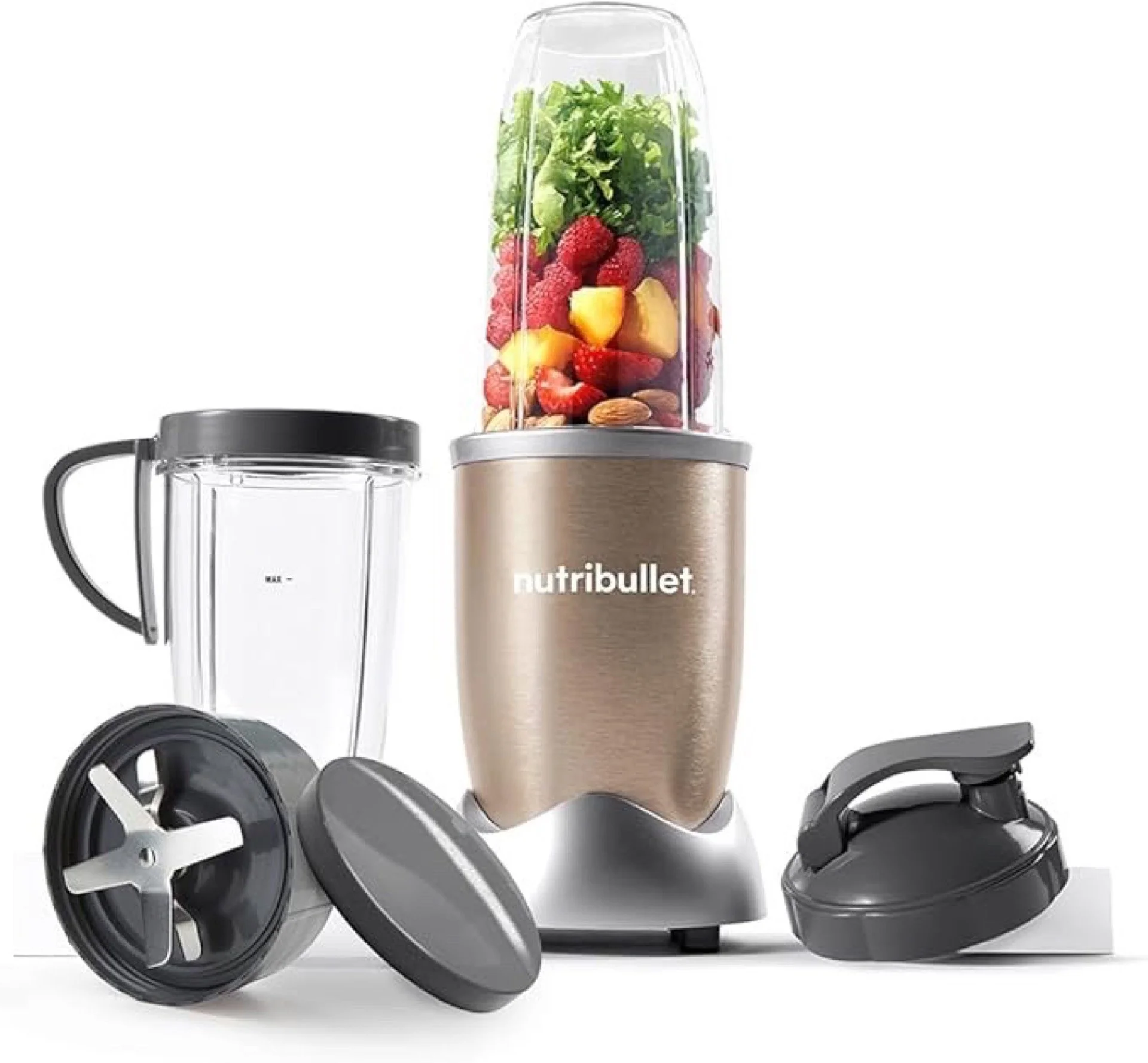
NutriBullet Pro 900
The NutriBullet Pro 900 is the benchmark most compact blenders are measured against. It has been on UK counters long enough to prove itself, and the track record holds up: it is fast, powerful for its size, simple to use, and reliable over months of daily use. For a straightforward home blending routine, it is hard to argue with.
Key Specifications
Motor: 900W, 24,000 RPM
Capacity: 900ml oversized cup, 600ml standard cup
Blade: 6-prong extractor, stainless steel
Controls: Push-down twist, one speed
Warranty: 1 year (2 years with registration via NutriBullet)
What it does well
Nine hundred watts in a personal blender is enough to handle the ingredients that trip up weaker machines. Frozen berries, oats, banana, protein powder and most everyday smoothie combinations blend cleanly in under a minute. The extractor blade design pulls ingredients downward rather than just spinning them, which means fewer dry pockets and a more consistent result from top to bottom of the cup.
The oversized 900ml cup is the right choice for anyone who wants a full morning smoothie without filling twice. The cups double as bottles with the lip ring lid attached. Blend, clip the lid, walk out. No decanting, no extra container to wash.
Operation is entirely frictionless. No speed settings, no presets, no learning curve. Push down, blend, done. Cleaning takes under 30 seconds: rinse the cup and blade under the tap and you are finished. Long-term owners consistently flag reliability as the Pro 900's strongest quality. It does the same job well every day and does not burn out.
The real-world complaints worth knowing
It is loud. This is the most common complaint across Amazon UK, retailer reviews and forum threads, and it is not exaggerated. At 900W pushing frozen ingredients, the Pro 900 is noticeably louder than the Ninja Blast and comparable to the Beast Mighty 850 Plus. Early morning blending in a shared flat is worth thinking about.
The one-minute run limit is real. For most smoothies this never comes up. For a dense, heavy blend with multiple thick ingredients you may need to stop, wait, and go again.
The rubber gasket under the blade assembly is the most common long-term failure point. Protein powder and fine ingredients collect underneath it if you only rinse the outside. When you clean, take the gasket off and rinse underneath it. Do this consistently and it is not a problem. Ignore it and it will eventually cause leaks.
Who should buy this
You want the most proven compact blender for daily home use
Your blends regularly include frozen fruit, oats or protein powder
You want reliable results without paying a premium
You blend once a day and want to be done in two minutes
Who should not buy this
You need cordless or portable blending
Noise in the morning is a genuine issue in your home
You want variable speeds or timed programs
Pros
900W handles frozen fruit, oats and protein powder without stalling
Cups double as bottles with the lip ring lid
Extremely fast to clean
Proven long-term reliability
Good value at the price
Cons
Loud, particularly with frozen ingredients
One-minute run limit on the motor
Blade gasket needs regular checking and cleaning underneath
One speed only
Available from
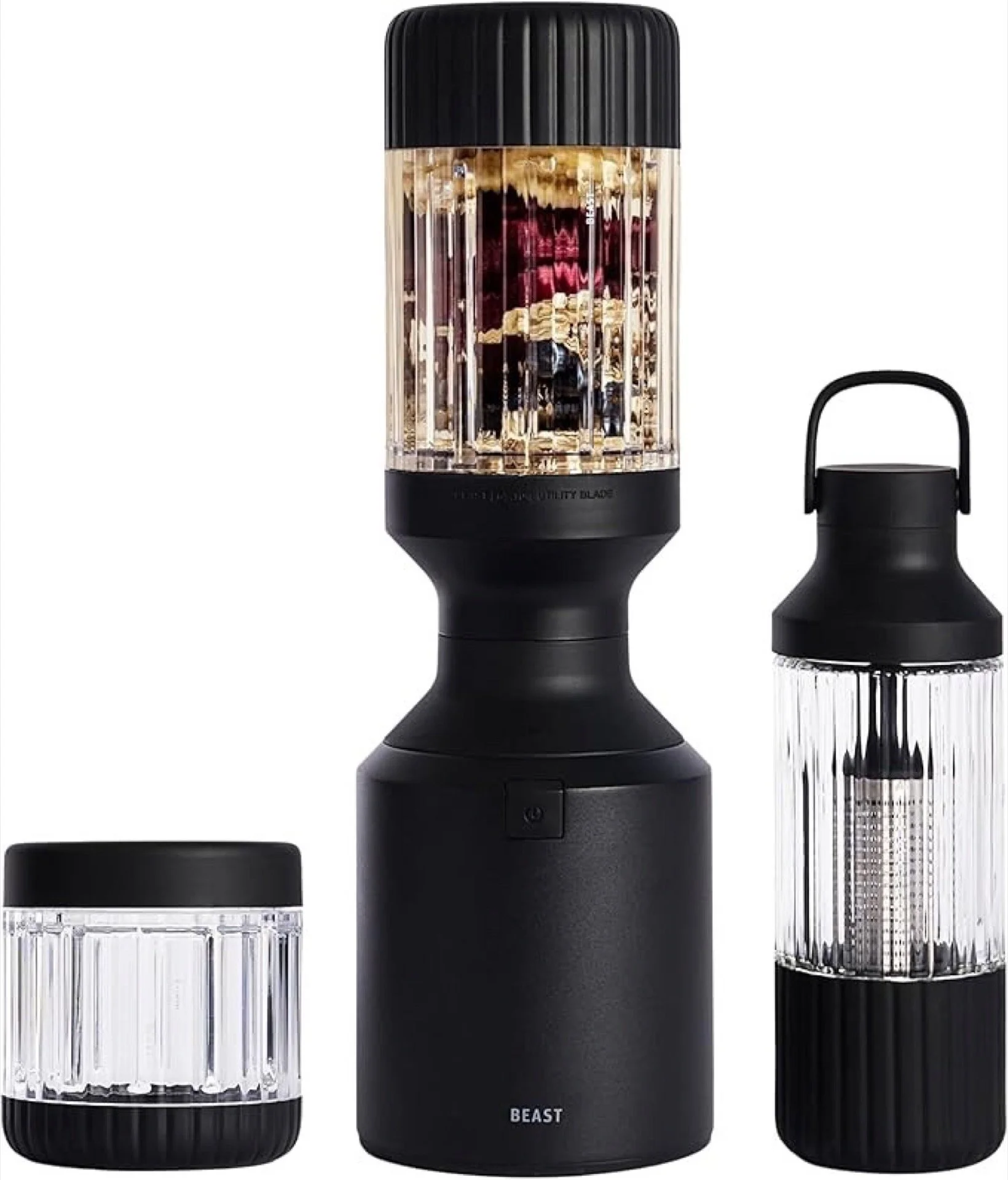
Beast Mighty 850 Plus
The Beast Mighty 850 Plus is the most capable blender in this guide. It is also the newest brand on this list: Beast Health launched in the UK in early 2025, designed by the founder of NutriBullet. That background shows in how the machine works. It takes what the NutriBullet format does well and improves on it in almost every area except price.
If you want the best blending performance available in a compact, single-serve format and you are prepared to pay for it, this is the one.
Key Specifications
Motor: 850W copper-coil
Capacity: Three vessels – 415ml, 638ml, 786ml (all BPA-free Tritan)
Blade: Stainless steel, four-angle extraction
Controls: Single button, timed 60-second blend cycle (three stages) + pulse
Warranty: 2 years
Includes: Three vessels, storage lids, drinking lid, carry cap, straw system, cleaning brushes
What it does well
The copper-coil motor is what separates the Beast from most compact blenders. Copper coils conduct electricity more efficiently than standard wiring, which means the motor maintains consistent speed under load without overheating. In practice, this matters: where a standard motor might slow when it hits resistance, the Beast keeps going. TechRadar found it capable of blending ingredients that most personal blenders leave in lumps.
The timed blend cycle runs in three stages: 20 seconds, 25 seconds, 15 seconds, with brief pauses between. This is not a gimmick. The pauses allow clumped ingredients to fall back toward the blade, which produces a more even result than one continuous run, particularly with leafy greens, fibrous fruit and dense powder blends. Trusted Reviews testing found it left fewer flecks and less grittiness than most personal blenders at this price.
The ribbed vessel design increases turbulence inside the cup. Combined with the four-angle blade geometry, ingredients get pulled into the cutting zone more aggressively than a standard extractor blade format. The practical result is smoother blends with less dry powder sitting at the top.
Three vessels is a genuine advantage. The 415ml cup handles dressings and sauces. The 638ml cup is the daily smoothie cup. The 786ml cup is for larger blends or batch prep. All three come with the Plus version. Tom's Guide's reviewer replaced their NutriBullet Pro 900 with the Beast specifically because of how well it handled dense, sticky ingredients like dates, which a NutriBullet typically struggles to blend finely enough.
Design is clean and intentional. Five colour options, a minimal footprint measuring just 10cm across the base, and premium-feeling Tritan vessels that do not cloud or scratch with daily use. It is a blender that looks good left on the counter.
The real-world complaints worth knowing
It is loud. T3's reviewer described it as the loudest blender they had tested at this size. The power that makes it effective also makes it noisy. A one-minute timed cycle at full power is not quiet. If early morning blending near light sleepers is a concern, this is not the machine to buy without thinking about that seriously.
The ribbed vessel interior is the main cleaning friction. Sticky ingredients like peanut butter, nut butters and fibrous greens collect in the ridges. Beast includes a long-handled cleaning brush for exactly this reason, and all three vessels are dishwasher-safe. But if you hand wash, it takes more effort than the smooth-walled NutriBullet cups.
The price is the other honest consideration. At £149.99, it costs significantly more than the NutriBullet Pro 900. For buyers whose blends are simple, the price is harder to justify. For anyone who blends demanding ingredients daily and wants the best result, the gap in performance is real and the price reflects it.
Ice crushing on its own is not the Beast's strongest suit. Multiple reviewers found it handles ice as part of a blend well, but crushing a cup of ice alone can leave a few chunks. For pure ice crushing, the NutriBullet Pro 900 is more consistent.
Who should buy this
You want the best blending performance available in a compact format
You blend demanding ingredients: thick powder blends, nut butter, dense frozen smoothies
Design matters alongside performance
You want three vessel sizes covered by one machine
Who should not buy this
You want cordless or portable blending
Simple blends are all you make — the price is hard to justify for banana and milk
Early morning noise near light sleepers is a real concern
You want to crush ice on its own regularly
Pros
Copper-coil motor maintains consistent speed under load
Timed three-stage blend cycle produces more even results than single-speed blending
Three vessels (415ml, 638ml, 786ml) all included
Ribbed vessel design increases turbulence for smoother blends
Premium design and build quality
Two-year warranty
Cons
Loud
Ribbed vessel interior requires more care when cleaning
Expensive for a personal blender
Struggles with ice crushing on its own
Available from
Which compact blender is right for you?
Three compact blenders, one clear verdict. Here's how they stack up.
| Blender | Best For | Avoid If | Power | Capacity | Warranty | Price |
|---|---|---|---|---|---|---|
| Ninja Blast | Blending without a socket | You mostly blend at home | Cordless | 470ml | 2 years | ££ |
| NutriBullet Pro 900 | Reliable daily home blending | You need cordless or quiet | 900W | 900ml / 600ml | 1 year | ££ |
| Beast Mighty 850 Plus | Best compact performance | Simple blends / noise concerns | 850W | 415ml / 638ml / 786ml | 2 years | £££ |

Top pick
Golden Egg Pick
The NutriBullet Pro 900 earns the Nest Tested Golden Egg Pick. Here is the honest case for it.
The Ninja Blast is excellent at what it does, but what it does is specific. If you blend at home most of the time and portability is not a genuine daily need, you are paying for something you do not use. The battery-powered motor has real limits on thick blends. The 470ml capacity is small. For a home blender, it is the wrong format.
The Beast Mighty 850 Plus is the better machine in pure performance terms. The copper-coil motor, the timed blend cycle, the three vessel sizes: it is more capable than the NutriBullet in almost every technical respect. But it costs roughly twice as much, it is louder, and the vessel ridges make cleaning more effort. For buyers who blend demanding ingredients every day and want the best possible result, it is absolutely worth it. For most people making a daily smoothie, the performance gap does not justify the price.
The NutriBullet Pro 900 hits the middle of that Venn diagram. It handles frozen fruit, oats and protein powder without stalling — the ingredients that cause weaker blenders to fail. The cups work as bottles. It cleans in 30 seconds. It has been on UK counters long enough that its reliability is not a claim, it is a track record. And it costs significantly less than the Beast without giving up the performance that most daily smoothie drinkers actually need.
The noise is real and the gasket needs attention. Neither is a reason to look elsewhere for most buyers.
If you genuinely need cordless, buy the Ninja Blast. If you blend demanding ingredients every day and want the best compact blender available, buy the Beast. For everyone else, the NutriBullet Pro 900 is the most sensible choice in this category.
Available from

The essentials
What to Know Before You Buy
Mini blenders fail in predictable ways. Most of them fail on the same few things: motors that slow under load, cup designs that leave dry pockets, run limits that interrupt the blend, and blade assemblies that are awkward to clean. Understanding these before you buy saves you returning a blender that looked good on paper.
Motor wattage is not the whole story. A 900W motor with standard coiling will slow down when it hits resistance. The Beast Mighty 850 Plus at 850W with copper coils maintains more consistent speed under load than many 900W rivals. What matters is whether the motor sustains power through thick ingredients, not what the box claims at peak output.
Run limits are a real constraint in this category. The NutriBullet Pro 900 has a one-minute maximum. The Beast's timed cycle is 60 seconds total. For a standard smoothie, neither is an issue. For a dense blend with multiple thick ingredients, both may require a pause before continuing. Cordless blenders have the additional constraint of battery depletion: a low charge produces noticeably weaker results.
Cup and vessel shape drives blending quality. A narrow tapered base creates a vortex that pulls ingredients toward the blade. A wide shallow base creates dead zones where ingredients sit untouched. This is why some lower-wattage blenders with well-designed vessels outperform higher-wattage machines with poor cup geometry. The ribbed interior of the Beast vessels increases turbulence further, pulling dense ingredients into the blending zone more aggressively.
Cordless only makes sense if you genuinely need it. A portable blender charges overnight, produces less power than a mains equivalent at the same price, and has a smaller capacity. If you blend at home every morning and occasionally take your cup out with you, you do not need cordless. You need a blender with a good travel lid. Only buy cordless if you will regularly blend somewhere without a socket.
Cleaning design matters before 8am. A smooth internal wall rinses under the tap in 20 seconds. A ribbed vessel or a complex blade assembly takes longer and creates friction in a morning routine. If cleaning becomes a chore, it gets skipped or done badly. Both outcomes are a problem over months of daily use.
Noise varies more than the specs suggest. None of the three picks here are quiet blenders. But there is a meaningful difference between a powerful, steady hum and a rattling vibration that sounds like the machine is about to leave the counter. The Ninja Blast is the quietest of the three by a clear margin. The Beast Mighty 850 Plus is the loudest. If early morning blending in a shared home is a real consideration, this should be a genuine factor in the decision.

Our process
How We Evaluated Our Picks
Mini blenders are sold on convenience. They fail on performance. The gap between what is claimed on the box and what happens with frozen ingredients and thick powder blends is wide for most models in this category. Our evaluation focused specifically on where compact blenders tend to fall short, and on which machines hold up after months of daily use, not just on first impression.
Motor performance under real load. Wattage figures are a starting point, not a verdict. We looked specifically at how each blender performs when it hits resistance: frozen banana, oats, protein powder, nut butter and dense leafy greens. These are the ingredients that separate a capable compact blender from one that stalls or produces a grainy result. Any machine with consistent reports of motor slowdown or failure within 12 months was removed from consideration.
Blend quality across ingredient types. We cross-referenced expert lab testing with long-term owner feedback across Amazon UK, Robert Dyas, Trusted Reviews, TechRadar and T3, focusing on texture outcomes: whether smoothies came out with remaining chunks, dry powder pockets, or gritty flecks. Models that produced consistent results across a range of common ingredients scored higher than models that performed well only on soft fruit.
Cup and vessel design. We assessed the geometry of each blending vessel: base taper, internal wall design, blade angle, and correlated this with reported blending consistency. A blender with a well-designed vessel can outperform a more powerful machine with poor cup geometry. This matters more in the compact category than in full-size blenders, because there is less room for the motor to compensate for design weaknesses.
Long-term reliability. Short-term reviews tell you how a blender performs new. We looked for patterns in reviews written after six months or more of regular use, and for recurring failure modes: gasket degradation, motor burnout, vessel cracking, blade dulling. Any model with consistent reports of the same failure point within a year of normal use was excluded.
Honest format assessment. A cordless blender was evaluated as a cordless blender with cordless constraints, not held to the standard of a mains-powered machine. A countertop machine was not penalised for not being portable. Each pick had to earn its place on its own terms.
Value in the UK market. Each recommendation had to justify its cost relative to the alternatives available to UK buyers. The cheapest option is not automatically the best value. The most expensive is not automatically the best performer. We looked at what each blender delivers for the price and whether that delivery is consistent over time.

From the goose's mouth
Frequently Asked Questions
What is a mini blender good for? Daily smoothies, protein shakes, soft frozen fruit blends and single-serve drinks. The best compact blenders also handle dressings, dips and small sauce portions. They are not built for batch blending, hot soups or heavy food processing.
Are mini blenders powerful enough for frozen fruit? The better ones, yes. The NutriBullet Pro 900 and Beast Mighty 850 Plus both handle frozen berries, banana and similar ingredients without stalling. Weaker compact blenders under 600W struggle. The Ninja Blast handles soft frozen fruit well for a cordless unit but has limits on very dense frozen blends.
Is the Beast Mighty 850 Plus worth the extra cost over the NutriBullet? If you blend demanding ingredients every day: thick powder blends, nut butter, dense frozen smoothies, the performance difference is real and the price reflects it. If your blends are straightforward, the NutriBullet delivers what you need for significantly less money.
Are cordless blenders worth buying? Only if you genuinely need to blend without a socket. Cordless blenders are less powerful than mains equivalents at the same price, have smaller capacities, and require charging. The Ninja Blast is the strongest cordless option in the UK at this price point. If you blend at home, a mains-powered machine is a better use of the money.
Why does my smoothie come out with dry powder at the top? Usually a cup geometry issue. Wide, flat-based cups create dead zones where powder sits untouched. Narrow-based cups with tapered bottoms create a vortex that pulls ingredients toward the blade. Add liquid first, then powder, then fruit. Avoid overfilling.
How do I clean the blade assembly properly? For smooth-walled cups like the NutriBullet: rinse immediately after use, check and clean underneath the rubber gasket regularly. For ribbed vessels like the Beast: use the included brush on the ridges, or put them in the top rack of the dishwasher. Do not let protein powder or nut butter dry in any blade assembly. It builds up and becomes a cleaning problem.
Which mini blender is best for protein shakes? For simple powder and liquid shakes, any of the three picks here will do it. For shakes with oats, frozen banana or nut butter, the NutriBullet Pro 900 or Beast Mighty 850 Plus. The Ninja Blast handles clean protein powder blends well; it struggles with added thick ingredients.